Calling everyone, every time, is the most expensive way to ship
By William Pereira ·
Teams that take quality seriously fall into one extreme: they either always fire the full ritual (product, architecture, security, every reviewer), or they never fire it and hope for the best. Both are expensive — one in people and model time, the other in incidents.
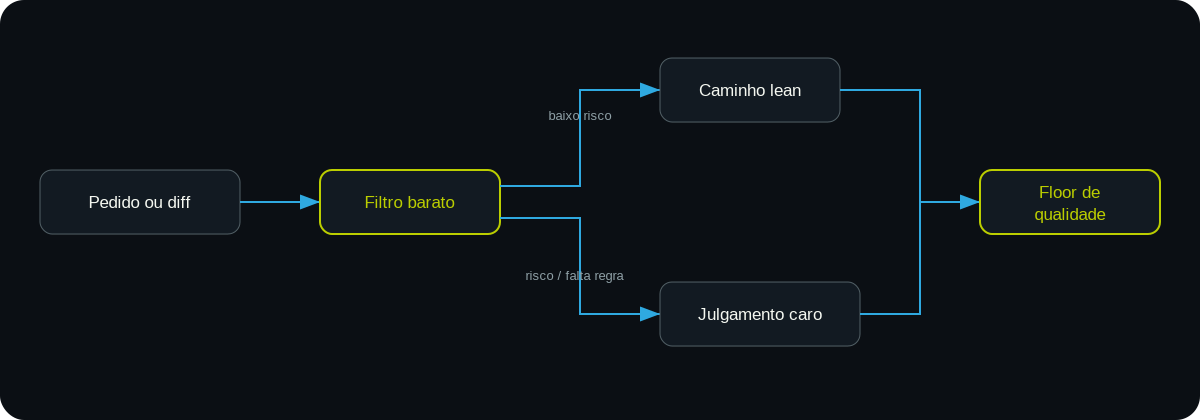
The alternative is separating the cheap filter from expensive judgment. A router (a script, explicit rules, signals in the request or the diff) decides whether the path is lean or full. The quality floor doesn't change; who you wake up does.
Always-full vs routed
| Always the full ritual | Router + floor | |
|---|---|---|
| Typographic chore | Same orchestration as an auth feature | Short path, same minimum checks |
| Feature with sensitive data | Same as the chore (or improvised) | Full profile triggered by risk |
| Marginal cost | High on everything | High only with evidence |
| Risk of shortcuts | Low on paper, high through fatigue | Controlled if the floor is real |
Why this isn't just process optimism
In operations and in product, triage has existed for decades: you don't escalate to the specialist at the first signal. In software — especially with model assistance — the cost of the “specialist” (a senior human or a heavy agent) became too visible to pretend that uniform orchestration is neutral.
The literature on the cost of late defects (Boehm; McConnell's synthesis) justifies not skimping on what is ambiguous or risky. The router justifies skimping on what is already well specified and free of risk triggers. They're two sides of the same coin: spend judgment where the error is expensive.
The care that separates engineering from theater: lean never means skipping tests or skipping the minimum review. It means not summoning roles whose domain doesn't even show up in the work.
Pros
- Less process fatigue on small changes.
- Risk and ambiguity stay expensive — on purpose.
- Works with or without agents: the filter can be a human checklist.
- Makes explicit what is policy (the floor) and what is optimization (the skip).
Cons
- Badly written triggers misclassify (false lean or false full).
- Without an explicit floor, “router” becomes an excuse for shortcuts.
- It needs maintenance: the list of risks and signals has to evolve with the product.
- At first, the team argues over the trigger table — that's work, not accidental overhead.
In practice
Write it down on a shared page: (1) lean-path signals — rules present, minimum tests, no auth, no sensitive data, no schema migration; (2) full signals — the inverse; (3) non-negotiable floor — request lint, N scenarios, at least one reviewer from the domain touched.
Automate the filter once the table stabilizes. Until then, a human applies the same table in a few minutes at the start of the session. Review the false positives in the retro: too lean and broke production, or too full on chores — both teach you something.
If you want to see an open source implementation of these patterns — one I maintain and use day to day — the repo is at github.com/pereirawe/codex-flow.