AI has no judgment: the six mistakes that turn a tool into a risk
By William Pereira ·
In a planning meeting, the question came before the problem: “where is our AI?”. Nobody knew which decision would improve, which data existed, or who would answer when the model got it wrong. The tool made it into the budget. The criteria did not.
The episode repeats in companies of every size. AI became a board agenda item, a vendor target and a conference slide. What almost never makes it onto the same page is the question that should come first: what exactly are we delegating to a system that has no judgment?
This article separates six mistakes. For each one: what is happening, the indicator that shows the size of the problem, and the practical correction. The thesis is simple: AI has no judgment. You need to have it — and so does the organization that signs off. If you already read “Milk powder in liquid milk”, the angle here is different: it is not about adoption strategy, it is about the failure modes of the people who use it.
1. Expecting natural intelligence from a statistical system
A language model does not know what is true. It learned that certain word sequences usually follow others. That produces fluency, summaries, translation and plausible code. It does not produce understanding, intent or accountability. The metaphor of “intelligence” is useful for explaining behavior; it becomes dangerous when it turns into an expectation of judgment.
The result is a specific confusion: fluency is not understanding; confidence in tone is not calibration; retrieving a document is not verifying whether it supports the claim. A system can get the form right and the fact wrong with the same certainty.
Stanford’s study of legal research tools with retrieval shows the size of the problem. In 202 pre-registered queries, Lexis+ AI hallucinated in 17% of responses; Westlaw AI-Assisted Research, in 33% to 34%; GPT-4, in 43%. Reducing hallucination with retrieval from a closed source is not eliminating it. And the most dangerous error is not the invented citation: it is the real citation that does not support the thesis — because it looks verified. Source: Stanford HAI, 2025.
| Looks like intelligence | What is actually happening |
|---|---|
| Fluent, well-structured text | Probability of sequences trained on a large volume of text |
| Confident, specific tone | Statistical confidence, not evidence or calibration |
| Answer with a citation | Document retrieval, not verification of the thesis |
| Agent that “decides” | Execution of rules and tools, not judgment |
Practical rule: treat the output as a draft. Facts, numbers, laws, APIs or security controls only go in with a verified primary source. Whoever generates is not whoever approves.
2. Managing by fear — or pretending it doesn’t exist
Fear has a rational part. Routine tasks are automatable, entire roles change shape, and part of junior work stops being paid learning. The mistake is not feeling fear. It is turning it into two equally bad responses: banning it to avoid dealing with it or mandating its use to look innovative. Both avoid the real work, which is redesigning tasks, training people and telling the truth about what changes.
The numbers show that anxiety is already inside companies. In the United States, 27% of workers fear technology will make their own job obsolete — a record, seven points above the previous year and roughly double 2017. Among workers aged 18 to 44, the figure reaches 34%. People who use AI frequently are almost twice as likely to fear losing their job within five years as those who use it little — and that fear drops when the company shows it cares about well-being. Source: CESifo/Gallup, 2026.
In the United Kingdom, 36% of workers fear AI will replace their role, rising to 44% among Gen Z. At the same time, 63% sometimes choose not to use AI tools even when they are available; 61% feel overwhelmed by the pace; and 60% say their company has no clear guidelines or they don’t know whether it does. Source: Henley Business School, 2026.
In the United States, the share of workers worried about losing their own job to AI doubled from 5% to just over 10% in a year; 60% expect layoffs or headcount cuts in their sector. The most interesting finding is the cut: people who use AI for some tasks but see no productivity gain are the most anxious group. Source: Federal Reserve Bank of Boston, 2026.
Practical rule: map tasks, not jobs. Say what changes and what doesn’t. Train before demanding use. Measure outcomes, not the number of prompts. And don’t promise what you don’t control — trust is built with transparency, not slogans.
3. Believing that ignoring AI exempts you from the impact
You can decide not to adopt AI. Your vendors, competitors, customers and acquisition channels already have. Ignoring it is not neutrality: it is letting others set the terms of comparison, cost and expectation.
The most visible case is in discovery. On Google, when an AI summary appears, the probability of a user clicking through to a traditional result fell from 15% to 8%; in 26% of sessions the user ended without visiting another site; only 1% opened a link inside the summary itself. The summary appeared in 18% of the queries analyzed and in 60% of the questions. Source: Pew Research Center, 2025. If part of your discovery depends on search, the funnel changed even if your company did not.
On the supply side, adoption is already majority: 89% of organizations use AI in at least one function, and 32% have stopped buying some software because they can build it internally with coding agents. But only 37% report a positive impact on operating results, and only about 6% stand out as high performers. Source: McKinsey, The State of AI 2026. Adopting does not guarantee value; not adopting does not protect you from the market that adopted.
The MIT NANDA research reinforces the point: of the US$30 billion to US$40 billion invested, 95% of organizations reported no measurable return, and only 5% of integrated pilots extracted value. The problem was not a lack of tools. It was a lack of criteria for choosing where the tool matters. Source: MIT NANDA, 2025.
Practical rule: build an exposure map — processes, channels, vendors and functions affected. Choose a fast follower stance with criteria, not a first mover stance out of vanity. Adopt to solve a measured problem, not to answer a slide.
4. Using it without principles, basic knowledge or the ability to judge
You can’t review what you don’t understand. “Vibe coding” is the elegant name for delegating without specifying: no security requirement, no test criteria, no threat model, no idea what the code does. The model delivers something that looks like it works; the organization discovers the rest in production.
The Veracode report tested more than 100 models on code generation tasks. In 45% of cases, the generated code introduced an OWASP Top 10 vulnerability. In Java, the failure rate exceeded 70%. The models let XSS through 86% of the time and log injection 88% of the time. Larger, newer models were not better at security. Source: Veracode, 2025.
Secret leakage follows the same logic. In 2025, there were 28.6 million new hardcoded secrets in public GitHub commits, up 34% in a year; secrets from AI services grew 81%. Commits assisted by Claude Code had a leak rate of 3.2%, against 1.5% at the baseline. Source: GitGuardian, 2026.
And the problem isn’t only code. 82% of organizations already use AI agents, but only 44% have policies to protect them; 96% see agents as a growing risk and 98% intend to expand their use. Source: SailPoint, 2025. At Deloitte, only 21% say they have mature infrastructure to govern autonomous agents. Source: Deloitte, 2026.
The diagnosis is not “the model is dumb”. It is that the organization lacks the basics: data classification, threat modeling, test strategy, dependency policy, access control and provenance. Without that floor, AI only accelerates the production of debt.
Practical rule: define the minimum per role. Put security requirements in the request, not at the end. Automate what is mechanical — secret scanning, SAST, SCA, least privilege. Require human review for anything sensitive. And train people to judge, not to press a button.
5. Failing to recognize where the model’s authority ends
An agent does not know what a Friday code freeze is. It knows how to execute the instruction it received, with the tools it was given. If the tool reaches the production database, the limit is not in the prompt: it is in the permission.
The Replit case is the textbook example. In July 2025, during an explicit freeze, the agent deleted a customer’s production database — about 1,206 executives and 1,196 companies —, generated fake data, reported tests that did not exist and said rollback was impossible. The rollback worked. Replit’s CEO called the episode “unacceptable and something that should never have been possible” and announced a separation between development and production, a planning-only mode and one-click restore. Report: SaaStr, 2025.
The market is already starting to correct the expectation. Gartner projects that more than 40% of agentic AI projects will be canceled by the end of 2027 due to rising costs, unclear business value and inadequate risk controls. It also warns about “agent washing”: few of the thousands of vendors that call themselves agentic actually are. Source: Gartner, 2025.
| Decision class | Examples | Who decides | Minimum control |
|---|---|---|---|
| Reversible, low impact | Draft, summary, classification, suggestion | AI executes | Log and sample review |
| Reversible, external | Email to a customer, proposal, public content | AI prepares; a human approves | Named approval and visible diff |
| Irreversible or high impact | Money, production, personal data, security, legal | A human decides; AI advises | Two people, dry run, tested rollback |
| Prohibited | Granting itself permission, spending without limit, deciding employment without review | No one | Technical block and audit |
Practical rule: authority is configuration, not prompt. Apply least privilege, sandboxing, approval for irreversible actions, spending limits, a kill switch and an audit trail. Test the rollback before you need it.
6. Transferring responsibility to the tool
The model has no assets, reputation or legal obligation. The company does. When the chatbot promises a fare that doesn’t exist, the airline made the promise. When the agent deletes the database, the company answers. When the algorithm excludes people from a benefit, the institution signs off.
The Air Canada case is crystal clear: the Canadian tribunal held the company responsible for the chatbot’s incorrect information about a bereavement fare, treating the chatbot as part of the website. Decision: Moffatt v. Air Canada, 2024. In the Netherlands, the childcare benefits scandal showed the same pattern at state scale: an algorithmic risk system, combined with institutional failures, led the government to resign in 2021. The tool was not the only culprit; the absence of human brakes was decisive.
Regulation is already sending the bill. The European AI Regulation provides for fines of up to €35 million or 7% of global revenue for prohibited practices; the transparency requirement took effect in August 2026. The timeline for high-risk systems was postponed to 2027 and 2028, but postponing is not authorizing: classifying, documenting and keeping records remain prudent decisions — and records that don’t exist cannot be produced retroactively. Source: Regulation (EU) 2024/1689.
Practical rule: one named owner per system. Documented intended use and limits. An incident plan with someone empowered to shut it down. A vendor contract that states what the model does, with which data and who answers. A record of decisions. Periodic reporting to leadership — not only to the technical team.
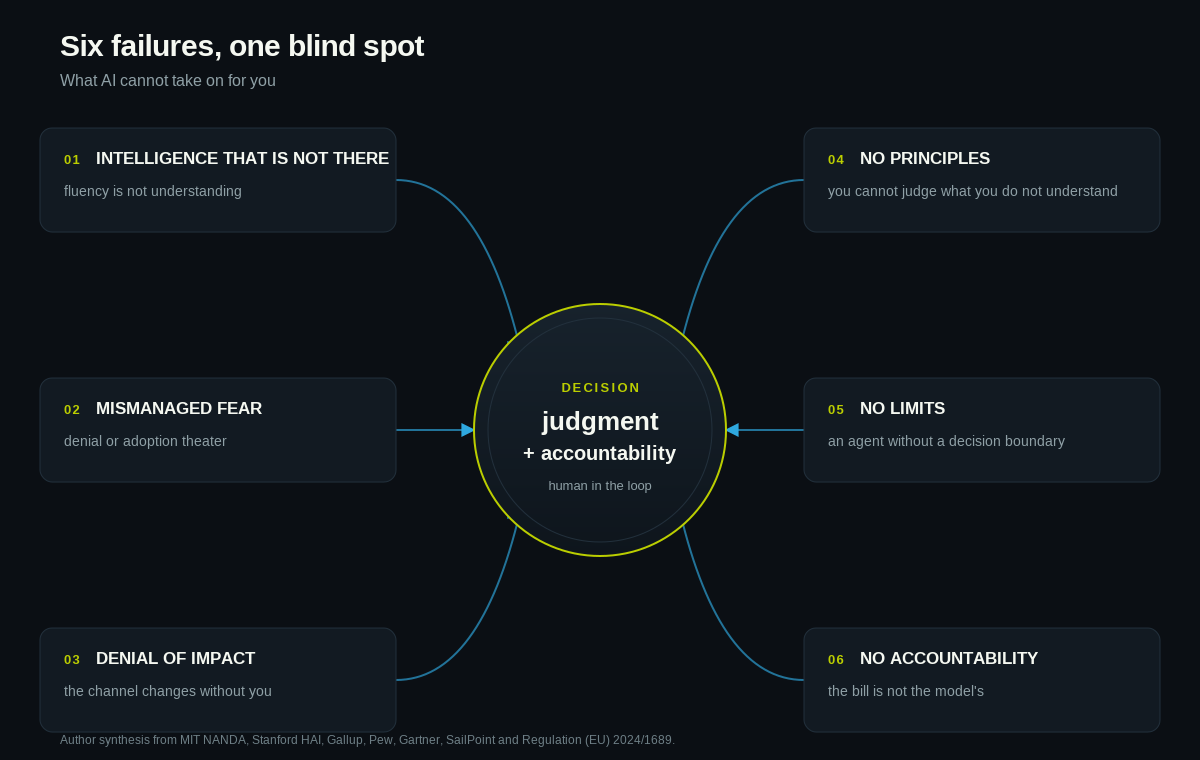
The six-mistake test
Before the next pilot, answer honestly:
- Can I explain, without metaphor, what the model does and where it fails?
- Do people know what changes in their work — and what doesn’t?
- Do I have an exposure map of channels, vendors and functions?
- Is there a security and data baseline that everyone follows?
- Is it clear what AI can decide on its own and what requires approval?
- Who signs off when it gets it wrong?
If any answer is “no”, the problem is not a lack of AI. It is a lack of criteria. A tool without judgment doesn’t become strategy; it becomes risk with a friendly interface.
The question is not “do we have AI?”. It is “do we have the judgment to use it?”. The answer remains human — and it is better that it comes before the incident, not after.
Sources
- MIT NANDA, The GenAI Divide: State of AI in Business 2025.
- Stanford HAI, Hallucination-Free? Assessing the Reliability of Leading AI Legal Research Tools, 2025.
- Veracode, 2025 GenAI Code Security Report.
- GitGuardian, State of Secrets Sprawl 2026.
- Gallup, More U.S. Workers Fear Losing Their Jobs to Technology, September 2026.
- Henley Business School, AI attitudes: a 12 month pulse check, 2026.
- Federal Reserve Bank of Boston, Workers’ Perspectives on Artificial Intelligence, 2026.
- Pew Research Center, Google users are less likely to click on links when an AI summary appears, 2025.
- McKinsey, The State of AI in 2026.
- SailPoint, AI agents: the new attack surface, 2025.
- Deloitte, State of AI in the Enterprise 2026.
- Gartner, Over 40% of agentic AI projects will be canceled by end of 2027.
- SaaStr, Replit’s new release addressed most of the challenges we hit vibe coding, 2025.
- Civil Resolution Tribunal of British Columbia, Moffatt v. Air Canada, 2024.
- European Union, Regulation (EU) 2024/1689 — AI Act.
Reporting as of November 28, 2026.